Built to Last, Gone in a Decade: Seven American Ghost Towns and the Psychology of the Endless Boom
Built to Last, Gone in a Decade: Seven American Ghost Towns and the Psychology of the Endless Boom
The historical record is, among other things, a graveyard of certainties. People who built opera houses in mining camps, who platted residential streets in railroad depots, who opened banks in fishing villages — they were not fools. They were human beings doing what human beings reliably do: assuming that the conditions of the present will extend indefinitely into the future. Psychologists have a name for this tendency. Historians have a more vivid one: they call the results ghost towns.
The United States produced ghost towns with unusual efficiency, partly because the country's westward expansion was driven by successive resource booms that moved fast, burned bright, and left quickly. What follows is a survey of seven of those places — not as curiosities, but as case studies in a recurring psychological pattern that has not diminished simply because we now have smartphones and macroeconomic forecasting.
1. Bodie, California — The Boomtown That Became a Textbook
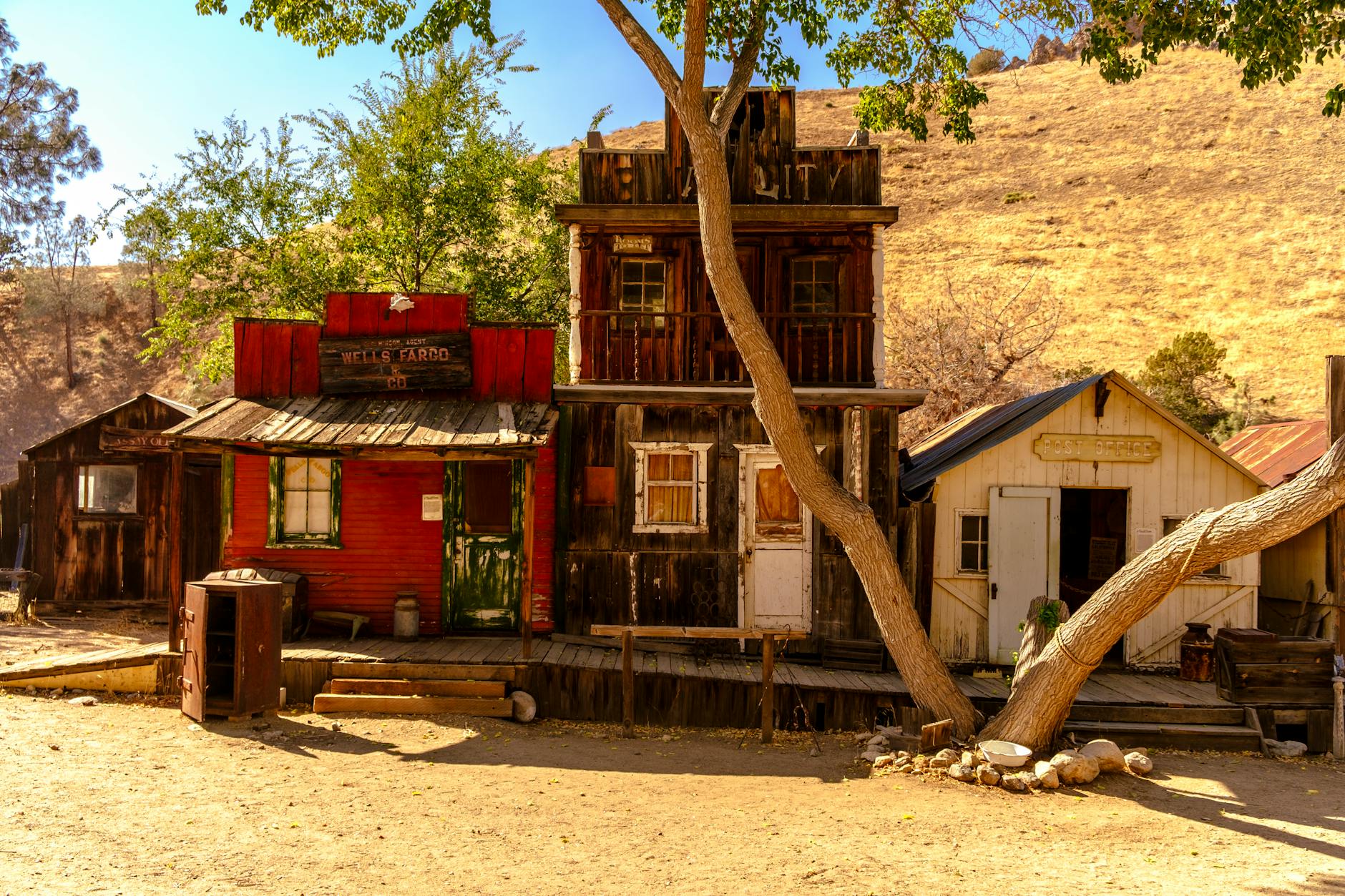
Bodie sits at 8,375 feet in the eastern Sierra Nevada, and today it is one of the best-preserved ghost towns in the country — a state historic park where buildings have been maintained in a state of "arrested decay," meaning they are stabilized but not restored. In 1879, Bodie had a population of approximately 10,000 people, 65 saloons, and a reputation for violence that was apparently well-earned.
The gold and silver that built Bodie were always finite. But at peak production, with millions of dollars leaving the mines annually, the psychological logic of permanence was overpowering. Schools were built. A foundry was established. A railroad spur was laid. By 1882, the richest ore bodies were exhausted. By 1920, fewer than 120 people remained. The last full-time resident left in the 1940s.
Bodie's arc illustrates what behavioral economists call optimism bias with unusual clarity: the consistent human tendency to overestimate the duration of favorable conditions. When the mine is producing, it is very difficult to believe it will stop.
2. Thurmond, West Virginia — Coal, Commerce, and a Population of Five
At its peak in the early twentieth century, Thurmond processed more freight tonnage than Cincinnati. It was a coal-shipping hub on the Chesapeake and Ohio Railway, and for a brief period it was genuinely prosperous — hotels, a bank, a bustling commercial district crammed onto a narrow strip of land between the New River Gorge and the railroad tracks.
The decline of Appalachian coal is a long story with many chapters, but Thurmond's collapse accelerated rapidly after World War II as diesel locomotives replaced steam engines and the demand for coal shifted. The 2010 census recorded a population of five. Five people, in a town that once processed industrial volumes of commerce.
What Thurmond represents is the danger of single-industry dependence — a town so thoroughly organized around one economic function that it had no adaptive capacity when that function changed. This pattern recurs so reliably across the historical record that it constitutes something close to a law.
3. Calico, California — The Silver Town That Sold Itself Twice
Calico produced approximately $86 million in silver during the 1880s, which in contemporary terms represents an enormous sum. It also produced borax, which extended its useful life slightly. By 1896, the price of silver had collapsed following the repeal of the Sherman Silver Purchase Act, and Calico followed it.
The town was later purchased by Walter Knott — of Knott's Berry Farm — who restored it as a tourist attraction, which it remains today. Calico thus achieved something unusual: it was commodified twice, first for its ore and then for its ruins. The second commodification has proven more durable than the first.
The lesson here is less about the initial boom and more about the speculative mania that accompanied silver mining generally. Investors in the 1880s were not ignorant of risk; they simply discounted it, as people in the grip of a boom reliably do.
4. Centralia, Pennsylvania — The Town That Is Still Burning
Centralia is a different kind of ghost town. Its population did not simply leave when a resource ran out; it was driven out by a mine fire that has been burning underground since 1962 and, by some estimates, may continue burning for another 250 years. The commonwealth of Pennsylvania condemned most of the town's properties in the 1980s and 1990s, and the current population is in the single digits.
What makes Centralia instructive is the decades-long reluctance of residents to accept the situation's permanence. Families fought condemnation, some for years, because the psychological cost of abandoning a place where one has built a life is enormous. This is not irrationality — it is a very human response to loss. But it also illustrates how sunk cost reasoning operates at the community level, binding people to circumstances that have already become untenable.
5. Rhyolite, Nevada — The Boomtown With a Stock Exchange
Rhyolite, near Death Valley, had a stock exchange. It had three newspapers, a school with 250 students, and an eight-story bank building. It also had a house built entirely from glass bottles, which survives today and has become the town's most photographed feature — an accidental monument to the era's extravagance.
The gold rush that built Rhyolite began in 1904. By 1911, the mines were failing. By 1920, the population was approximately 14. The bank building's shell still stands. The stock exchange does not.
Rhyolite's particular contribution to this catalog is the speed of its collapse — from a functioning city to near-abandonment in under a decade. That velocity reveals how quickly speculative infrastructure can become worthless when the underlying asset disappears.
6. St. Elmo, Colorado — The Town That Almost Made It
St. Elmo is among the most intact ghost towns in Colorado, which is saying something in a state with an unusually high concentration of them. It was a gold and silver mining town that peaked in the 1880s and survived longer than most because a single family, the Starks, stayed on and maintained it well into the twentieth century.
The Stark family's persistence is itself a psychological case study — an attachment to place so strong that it outlasted any economic rationale. Today, St. Elmo is a hiking and off-road destination. The cabins are still standing. The general store is a museum.
St. Elmo suggests that place attachment, the emotional bond between people and specific locations, can sustain a community's physical fabric even after its economic reason for existing has dissolved. It does not, however, sustain a population.
7. Kennecott, Alaska — The Copper Town at the End of the World
Kennecott sits in a remote valley in what is now Wrangell-St. Elias National Park, accessible only by a sixty-mile dirt road. At peak production in the early twentieth century, it was extracting copper ore of exceptional purity and generating enormous profits for its owners, the Guggenheim family.
The ore ran out in 1938. The company gave workers four days' notice and shut the operation entirely. The buildings — a fourteen-story mill, a power plant, warehouses, a hospital — were simply left. The cold, dry Alaskan climate has preserved them in remarkable condition.
Kennecott's shutdown was not a gradual decline but an instantaneous decision made by people who had always understood the mine was finite. The workers who lived there had not necessarily shared that understanding. That asymmetry of information — between those who own the boom and those who depend on it — is a recurring feature of resource extraction communities that the historical record documents with depressing consistency.
The Pattern Is the Point
Every current boomtown in the United States — every city whose prosperity depends on a single commodity, a single employer, a single technology wave — sits somewhere on the arc that these seven places have already completed. That is not pessimism. It is what the record shows.
The human tendency to discount future risk in the presence of current prosperity is not a flaw that education or information reliably corrects. It is a deep feature of how people process time and uncertainty. The ghost towns scattered across the American landscape are not monuments to stupidity. They are monuments to a psychology that has not changed, and that the historical record — if we are willing to visit it, and to read it honestly — documents in extraordinary detail.