When Washington Chose Water Over Home: The Federal Drowning of American Towns
When Washington Chose Water Over Home: The Federal Drowning of American Towns
In 1956, the residents of Enfield, Massachusetts, received a letter that would have been familiar to any Roman citizen whose farm lay in the path of a new aqueduct: your home now serves a greater good, and you will move. The Metropolitan District Commission needed their valley for the Quabbin Reservoir. Within four years, Enfield had vanished beneath forty feet of water, along with three neighboring towns and 2,500 graves that had to be relocated before the flooding began.
Enfield was not unique. Between the New Deal and the 1970s, federal agencies systematically drowned dozens of American communities, displacing tens of thousands of residents in what amounted to the largest peacetime exercise of eminent domain in the nation's history. The psychology of these erasures—how communities responded, how some residents never emotionally relocated even decades later, and how local identity persisted underwater—reveals something ancient about the relationship between centralized authority and the places ordinary people call home.
The Arithmetic of Sacrifice
The Army Corps of Engineers and the Bureau of Reclamation approached town-drowning with the dispassionate efficiency that Rome once brought to aqueduct construction. The calculation was always the same: the needs of distant cities outweighed the attachment of local residents to places their families had inhabited for generations. When the Corps surveyed the Susquehanna River valley in Pennsylvania during the 1960s, they identified twelve communities that would need to disappear for the Raystown Lake project. The residents' protests were noted in the environmental impact statements and then systematically ignored.
This was not malice but mathematics. Federal engineers had inherited the Roman understanding that infrastructure serves the many at the expense of the few, and that emotional attachment to place—however profound—cannot be quantified in cost-benefit analysis. The Quabbin Reservoir would provide water for Boston. The Kentucky Lake would generate electricity for the Tennessee Valley. The individual tragedies of displacement were, in bureaucratic terms, externalities.
The Psychology of Forced Migration
The human response to these federally mandated erasures followed patterns that anthropologists would recognize from any forced migration in history. Some residents never left emotionally, even after their physical departure was complete. In the 1990s, forty years after the flooding of the Swift River Valley in Massachusetts, former residents still gathered annually for "Quabbin reunions," sharing photographs of streets that existed only in memory and maintaining social connections to a place that no longer existed above water.
This psychological persistence of drowned communities reflects something deeper than nostalgia. Place attachment operates independently of physical reality—a phenomenon that would have been familiar to any exile in ancient Rome who continued to identify with a hometown they would never see again. The difference was that these American communities had been deliberately destroyed by their own government, creating a unique form of civic grief.
The Technology of Erasure
The federal drowning of American towns required more than engineering; it demanded the systematic dismantling of community identity. Before the water rose, crews removed everything that might interfere with the reservoir's function: houses were demolished or relocated, cemeteries were excavated and moved, and roads were rerouted. The process resembled nothing so much as the Roman practice of damnatio memoriae—the deliberate erasure of a person or place from official memory.
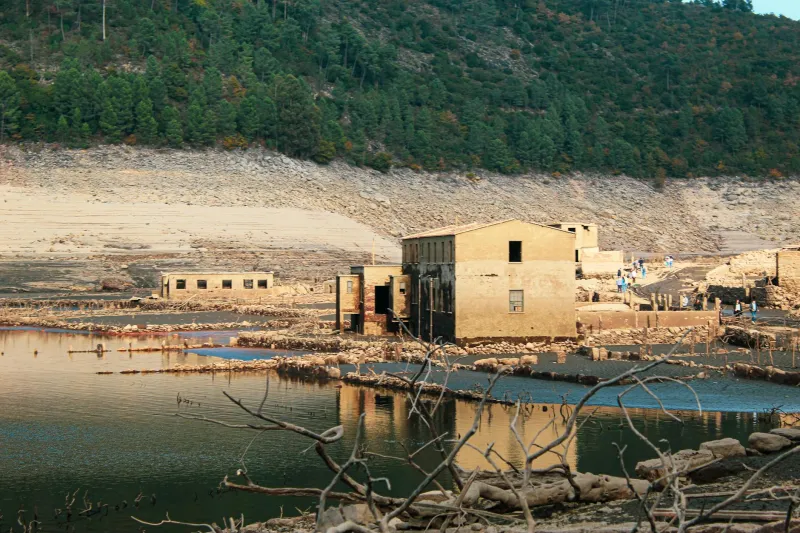
Yet complete erasure proved impossible. In drought years, when reservoir levels dropped, the foundations of drowned towns reemerged like archaeological sites. Former residents would drive to boat launches and point to spots in the water where their childhood homes had stood. The federal government had succeeded in destroying the physical communities but had failed to eliminate the psychological geography that connected people to place.
The Ancient Pattern of Expendable Places
Every empire that ever built large-scale water infrastructure made identical calculations about whose land was expendable. When Rome constructed the aqueducts that supplied water to a million residents, they displaced thousands of farmers whose individual claims to ancestral land meant nothing against the needs of the imperial capital. When China built the Three Gorges Dam in the 1990s, they flooded communities that had existed for centuries, relocating 1.3 million people with the same bureaucratic efficiency that American engineers had perfected decades earlier.
The pattern reveals a consistent truth about centralized power: it values places differently than the people who inhabit them. To federal planners, a town is a collection of structures and economic functions that can be relocated or replaced. To residents, it is an irreplaceable constellation of memory, relationship, and identity that cannot be reconstructed elsewhere.
The Persistence of Underwater Memory
The most striking aspect of America's drowned towns is how completely they failed to disappear from human consciousness. Decades after the flooding, former residents maintained detailed mental maps of submerged neighborhoods. They could navigate by memory to spots in the reservoir that corresponded to specific houses, churches, or crossroads. The water had eliminated the physical community but had somehow intensified the psychological one.
This persistence suggests something important about the relationship between place and identity that federal planners never understood. Physical destruction of a community does not eliminate its psychological reality for the people who lived there. Instead, it often preserves that reality in a form that cannot be altered by subsequent development or change—a perfect, underwater museum of what once was.
The towns that voted to drown—though "voted" overstates their agency in the process—became involuntary experiments in the durability of place attachment. Their residents discovered what refugees and exiles throughout history have learned: that the most important geography exists in memory, and no amount of federal authority can flood that particular territory.