Dinner at the Edge of Empire: How a Chain of Restaurants Invented the Taste of the American West
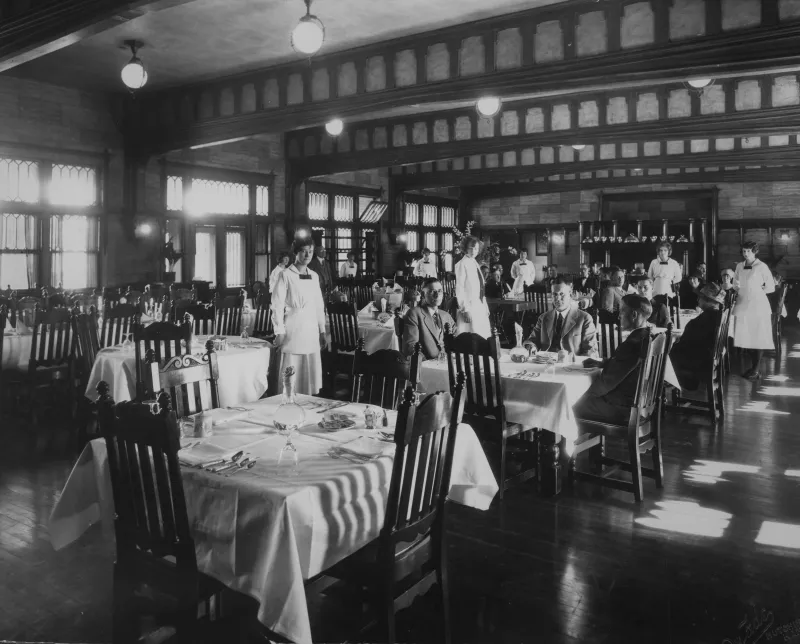
Photo: vintage Harvey House railroad restaurant dining room historic photo, via d3h6k4kfl8m9p0.cloudfront.net
History is the only lab that never closes, and its longest-running experiment may be this one: what happens when you tell people who they are by controlling what they eat? The Fred Harvey Company ran that trial for nearly a century along the Santa Fe Railway, and the results are still on the menu.
The Problem of the Bad Meal
In the 1870s, eating aboard a train or at a rail-side lunch counter was a gamble with your digestion. Travelers heading west faced greasy coffee, dubious meat, and hurried service at depots where the food contract went to the lowest bidder. Fred Harvey, a British-born immigrant who had failed at more modest ventures, saw the gap and understood something his competitors did not: the railroad wasn't selling transportation. It was selling the experience of the frontier, and the experience was inedible.
Harvey's insight was almost accidentally philosophical. If travelers arrived in the West expecting something wild and unfamiliar, then the most radical thing a restaurant could do was serve them the familiar—flawlessly, identically, in Topeka and Albuquerque and Needles. The filet mignon at the Albuquerque Harvey House was the filet mignon in Kansas. The coffee was cut to a company standard, sampled by inspectors the way a laboratory audits its own results. Passengers weren't tasting the West. They were tasting consistency, and consistency felt like civilization.
Manufacturing Authenticity, One Souvenir at a Time
Here is where the experiment gets interesting. Once you have taught a nation that its regions are consumable, the next step is to decide what those regions taste like. The Harvey Company, working hand in glove with the Santa Fe, became one of the great curatorial forces in American culture. Its dining rooms and adjacent hotels—many designed with architect Mary Colter, who conjured buildings that looked older than they were—popularized a Southwestern aesthetic of exposed timber, Navajo blankets, Pueblo-revival silhouettes, and painted desert sunsets.
The irony is thick enough to spread. Much of the food on those tables came nowhere near the landscape outside the window, and the "authentic" Native American decor was selected, priced, and displayed by a corporation in Chicago. But the millions of tourists who passed through didn't experience it as fabrication. They experienced it as arrival. The Harvey House told them what the West looked like, and then handed them a napkin.
This is a pattern the record shows again and again: regions do not present themselves to the national imagination. They are staged, and the staging is an act of commerce. New England's whitewashed villages, the antebellum South's columned gentility, the cowboy West itself—each was partly a branding decision made by people selling tickets.
The Harvey Girls: Respectability as a Hiring Strategy
The company's second act was social. To staff its dining rooms, Fred Harvey recruited single women—thousands of them over the decades—offering signed contracts, housing in supervised dormitories, a curfew, and wages that outstripped most alternatives available to unmarried women in the Gilded Age. These were the Harvey Girls, and they became one of America's first large-scale respectable workforces for women without husbands or inheritances.
The arrangement was paternalism with excellent posture. The company policed romance, hemlines, and off-duty conduct, understanding that its product was not merely food but moral theater: the reassurance that a lone male traveler could eat a white-tablecloth dinner in the wilderness served by a woman of unimpeachable character. Yet the constraint cut both ways. The job put young women on trains and deposited them in towns from Kansas to California, far from the parlors they were raised in. Judy Garland's 1946 MGM musical later mythologized them, but the real women needed no embellishment—many stayed, married locally, and became the civic fabric of towns that the railroad had conjured from nothing.
The lesson for the present is uncomfortable and clarifying. Workplace opportunity and workplace control arrived in the same envelope, and the women who took the deal knew it. Human beings have always traded autonomy for security at rates the market sets; the Harvey Girls simply negotiated in a currency of respectability.
What the Chain Left Behind
The Harvey House system faded as automobiles and airlines dissolved the railroad's monopoly on how Americans saw their own country. Many buildings closed; a few—like the magnificent El Tovar at the Grand Canyon's rim, still operated within the lineage—endure as destinations in their own right.
But the deeper legacy is epistemological. Americans still meet their regions through standardized experiences that promise authenticity: themed visitor centers, curated heritage districts, national park lodges designed to feel timeless. We do not discover our geography. We consume a version of it that someone packaged, and the packaging is so good we mistake it for the thing itself.
That is not a modern corruption. It is a five-thousand-year-old constant. People have always preferred the region that flatters their expectations, and the entrepreneurs who understood this first were never selling dinner. They were selling a belief—and the belief, like the coffee, was served hot and identical at every stop.