Color-Coded Compliance: The Long History of Maps Designed to Change What Americans Believe
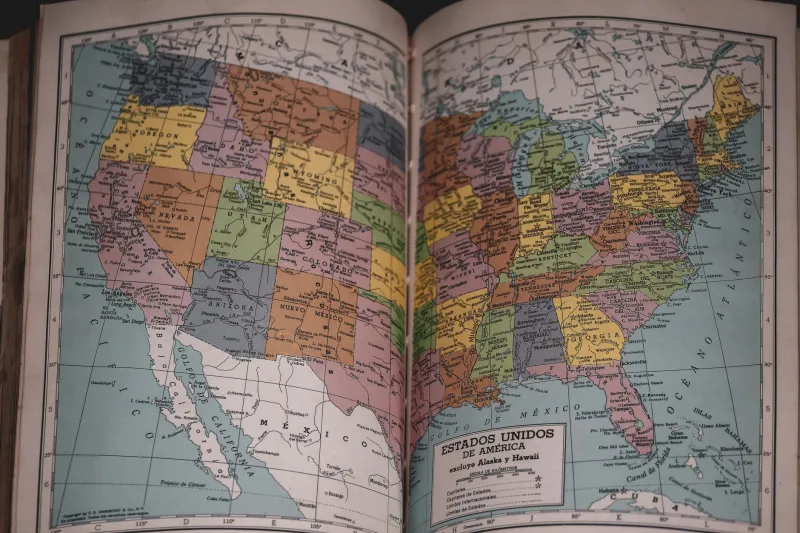
A map is an argument wearing the costume of a fact. This has always been true, and the people who commission maps have generally understood it better than the people who read them. The history of American federal cartography is, in significant part, a history of psychological persuasion conducted at a scale and with a subtlety that more explicit propaganda could never achieve. A poster tells you what to think. A map shows you what is—and leaves the conclusions, seemingly, to you.
Human beings have not changed in five thousand years. We have always been more susceptible to information presented as objective description than to information presented as argument. The genius of the well-designed map is that it never appears to be making a case.
The Red Lines That Redrew America
The Home Owners' Loan Corporation, established in 1933 as part of the New Deal's effort to stabilize the collapsing American mortgage market, produced between 1935 and 1940 a series of residential security maps covering 239 American cities. The maps used a four-tier color-coding system to grade neighborhoods by their perceived investment risk. Green indicated the safest areas. Blue suggested still-desirable but slightly older stock. Yellow warned of declining neighborhoods. Red marked areas the HOLC considered hazardous to lenders.
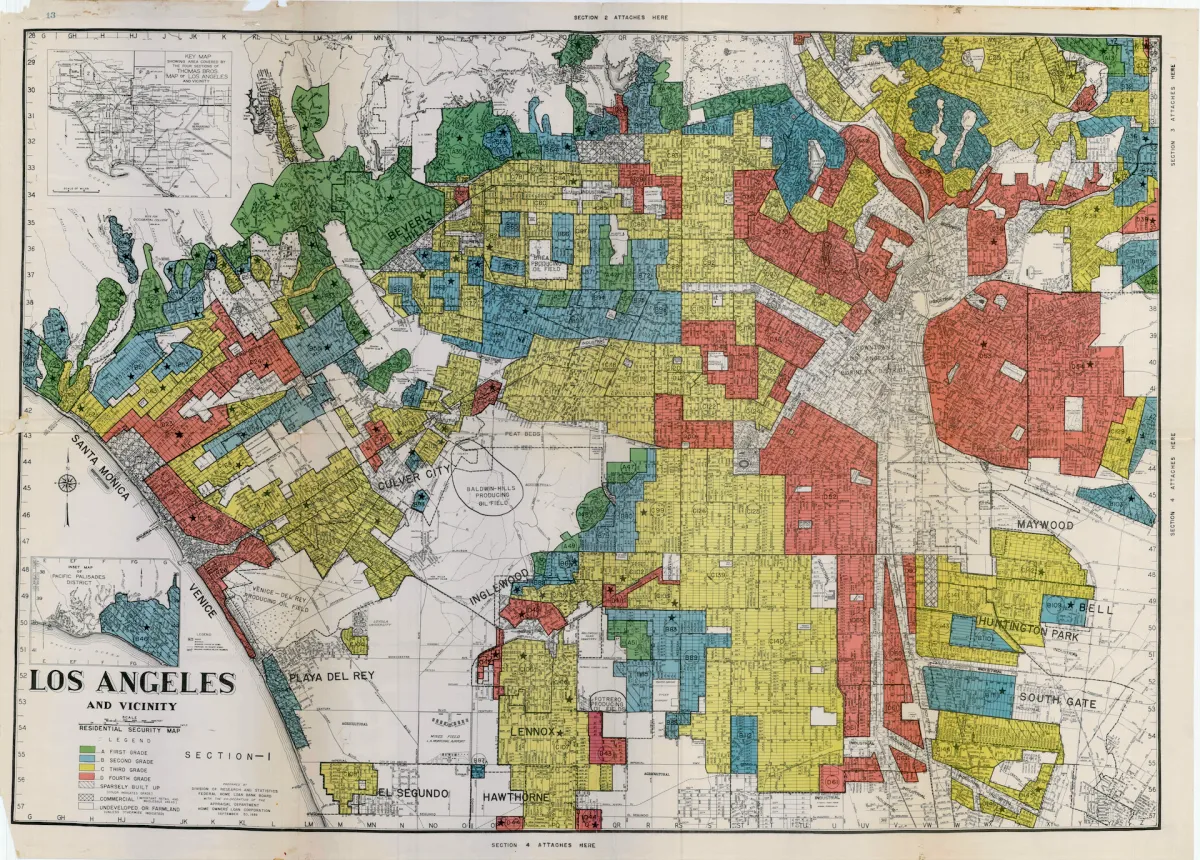 Photo: Home Owners' Loan Corporation, via scalar.usc.edu
The criteria for the red designation were not purely economic. HOLC appraisal manuals explicitly instructed assessors to consider the racial composition of a neighborhood as a negative factor. The presence of Black residents, immigrants, or Jews was coded as risk. The maps did not say, in plain language, that certain Americans should be denied mortgage credit because of their race. They showed, in calm cartographic authority, that certain neighborhoods were simply less safe investments than others. The distinction between those two statements is the entire mechanism.
The consequences were not subtle. Banks and insurance companies that had contributed data to the HOLC process used the resulting maps as lending guides. Neighborhoods colored red were denied conventional mortgage financing for decades. Unable to borrow for purchase or improvement, residents watched their properties deteriorate—which confirmed, in subsequent assessments, that the original red designation had been accurate. The map created the conditions it claimed to describe.
This is among the most efficient forms of institutional coercion ever devised: present a prediction as a diagnosis, and then enforce the prediction until it becomes indistinguishable from truth.
Measuring Distance from the Fireball
If the HOLC maps taught Americans what neighborhoods to avoid, the civil defense cartography of the 1950s and 1960s taught them something more fundamental: how to calculate the precise distance at which they would survive a nuclear detonation. Blast radius maps—concentric circles of annihilation radiating outward from target cities—appeared in school pamphlets, civil defense manuals, and government publications with a frequency and casualness that, viewed from the present, seems almost hallucinatory.
The psychological function of these maps was not, despite appearances, to inform. Americans who studied blast radius charts were not thereby equipped to survive a nuclear attack. The charts were too abstract, the variables too uncertain, the scenarios too catastrophic for the information to translate into meaningful personal action. What the maps actually accomplished was the normalization of nuclear threat as a manageable, mappable, plannable category of risk—something that could be survived with the right preparation and the right distance from the wrong zip code.
This normalization served specific policy purposes. A population that believed nuclear war was survivable was a population that could be organized around civil defense programs, that could be encouraged to build fallout shelters, that could be persuaded to accept the ongoing costs and risks of the Cold War arms race as a reasonable exchange for security. A population that understood nuclear war as simply unsurvivable was a population that might ask different questions about the policies that made such a war possible.
The maps chose the first interpretation and presented it as geography.
The Invisible Architecture of Risk
Contemporary Americans encounter government-produced risk maps with a frequency that would have been unimaginable to a citizen of 1950. The Federal Emergency Management Agency's flood zone maps determine mortgage requirements, insurance costs, and development permissions for millions of properties. The Environmental Protection Agency's air quality index maps, updated daily and distributed through weather applications on every smartphone, shape decisions about where children play and where elderly residents venture outdoors. Crime mapping platforms, many of them maintained or subsidized by municipal governments, display incident density in color gradients that have been shown, in peer-reviewed research, to influence real estate decisions, business investment, and even jury behavior in criminal trials.
 Photo: Environmental Protection Agency, via logodix.com
None of these maps are fraudulent in the way that the HOLC maps were fraudulent. Their methodologies are, in most cases, more transparent and more defensible. But they share with their predecessors the essential characteristic of all persuasive cartography: they present a choice of what to measure, how to weight it, and how to display it as if those choices were invisible—as if the map were simply showing what is there.
Flood zone designations are drawn from historical data that does not account for changing precipitation patterns. Crime heat maps aggregate incident reports without distinguishing between neighborhoods where crime is more frequent and neighborhoods where police presence is more intensive. Air quality indexes measure what monitoring stations detect, and monitoring stations are not distributed randomly across the landscape of any American city.
The Consistent Pattern
What connects the HOLC maps of the 1930s, the blast radius charts of the 1950s, and the digital risk maps of the present is not malicious intent—though malicious intent was certainly present in the first case and arguably present in others. What connects them is a consistent feature of human psychology that has not changed across the five millennia for which we have evidence of it: people believe what appears to be shown to them more readily than what is argued to them.
The map exploits this tendency with unusual efficiency because it also exploits a second consistent feature of human cognition: we are poor at identifying the assumptions embedded in visual representations. We can argue with a sentence. We struggle to argue with a color.
Record of Places exists on the premise that every location is a record of the decisions, pressures, and psychological patterns of the people who made it. The maps that shaped American neighborhoods, American fears, and American real estate values are among the most revealing documents in that record—not because they show us places, but because they show us, with unusual precision, what powerful institutions wanted ordinary people to believe about them.