Whose Name, Whose Land: The Political Cartography of Erasing Indigenous America
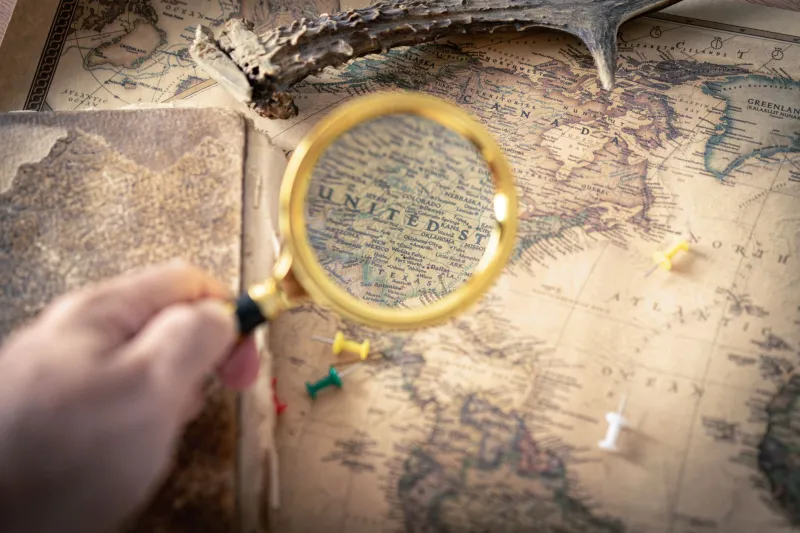
When European settlers renamed the rivers, mountains, and valleys of North America, they were not simply filling in blank spaces on a map. They were executing one of the oldest and most effective instruments of conquest: the deliberate erasure of someone else's claim to a place through the annihilation of its name. The cartographers who redrew Indigenous America did not always act out of ignorance. More often, they acted out of purpose.
The history of place names on this continent is, at its core, a history of who was allowed to say they belonged somewhere — and who was not.
The Name as Deed
Long before a government could issue a land patent or a court could record a title, a name served as the most portable and durable form of territorial claim available to human beings. Indigenous nations across North America had been naming their landscapes for thousands of years. Those names encoded ecological knowledge, spiritual meaning, historical memory, and social geography into the land itself. The Haudenosaunee called the great lake to their west Kanadario — roughly, "sparkling water." The Lenape called their river Lenape Sipu, the river of the people. These were not decorative labels. They were assertions of relationship.
European colonizers understood this intuitively, even when they did not say so plainly. Renaming was not a bureaucratic formality. It was a statement: the previous occupants' relationship to this place no longer counts. The act of renaming converted a living landscape full of Indigenous meaning into a blank surface upon which a new story could be written.
That psychological mechanism — the need to narrate ownership through naming — has never been unique to European colonizers. It is as old as the first human being who pointed at a hill and called it something. What was distinctive about the colonial project in North America was its systematic, continental scale.
The Cases Where the Names Survived
Not every Indigenous name was erased. Some survived because they were too deeply embedded in the speech of early settlers to be dislodged. Others survived because they were phonetically adapted into English or Spanish in ways that obscured their origins while preserving their sounds.
Massachusetts, Connecticut, Mississippi, Illinois, Ohio, Michigan — roughly half of the United States carries a state name derived from an Indigenous language. This is frequently cited as evidence of cultural respect, but the record is more complicated. Many of these names survived precisely because they referred to geographic features or regions so large that no single European power could plausibly rename them without the new name failing to stick. The Mississippi River was simply too vast and too central to the continent's geography to be renamed by English, French, and Spanish colonizers who were already fighting over what to call it among themselves. The Ojibwe word misi-ziibi — great river — won by default.
Where Indigenous names did survive intact, they frequently survived as geographic fossils: the name remained while everything the name once signified was stripped away. Chesapeake Bay retains its Algonquian roots, but the nations who gave it that name were dispossessed of its shores within a century of European contact. The name became, in effect, a trophy — preserved as a curiosity while the people who created it were rendered invisible.
The Cases Where the Names Were Weaponized
There is a more troubling category: places where Indigenous names were retained not out of indifference or inertia, but as instruments of mockery or diminishment. Across the American South and Midwest, settlers occasionally preserved Indigenous place names precisely because they found them exotic — useful for lending a romantic, frontier quality to otherwise unremarkable towns. The name was kept; the people were removed.
This dynamic was particularly visible in the decades following Indian Removal in the 1830s. Towns in Alabama, Tennessee, and Mississippi adopted Muscogee and Cherokee place names even as the populations who had spoken those languages were being force-marched westward. The names became decorative, stripped of their original referential power and redeployed as local color. Human psychology does not require malice to produce this outcome. It requires only the universal tendency to treat the symbols of a defeated group as available for appropriation once the group itself has been rendered powerless.
The Cases Where the Names Were Obliterated
Then there are the places where the erasure was total and deliberate. The Black Hills of South Dakota — Pahá Sápa in Lakota, the heart of everything that is — were renamed by an 1874 geological survey led by George Armstrong Custer, who had been sent to confirm rumors of gold. The expedition's cartographers assigned English names to peaks, creeks, and valleys that the Lakota had named and inhabited for generations. Within two years of that survey, the United States government had violated the Fort Laramie Treaty and opened the region to white settlement.
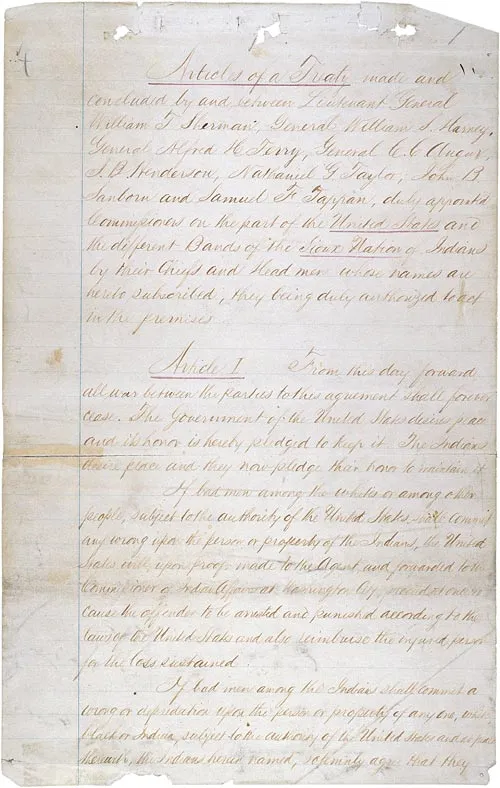 Photo: Fort Laramie Treaty, via www.archives.gov
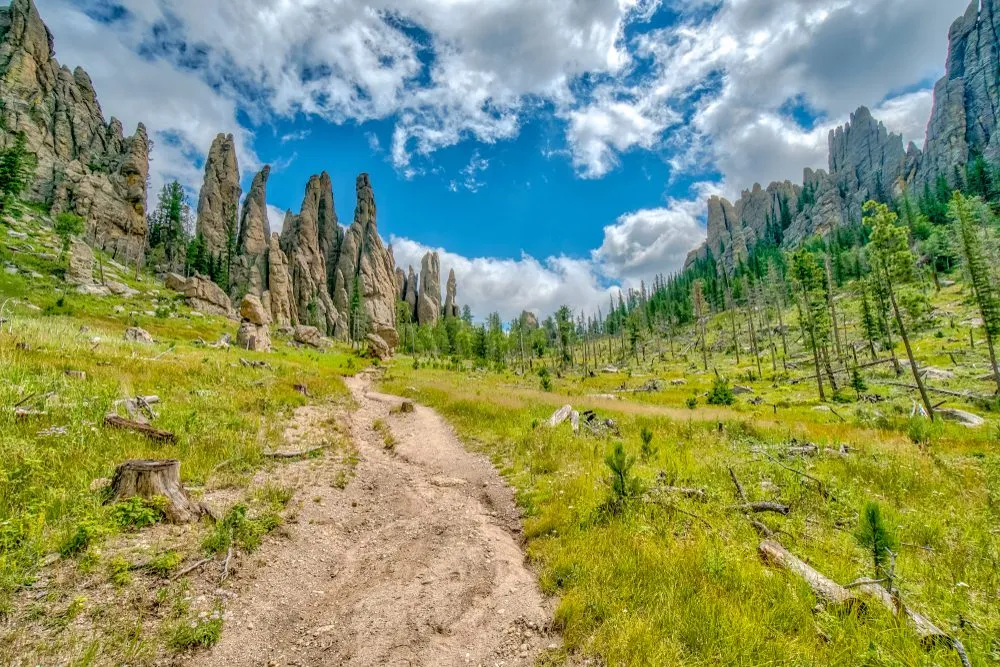 Photo: Black Hills, via rushmoreexpress.com
The cartographic erasure preceded the physical dispossession by months. The map was the argument. Once a place appeared on a government map under a new name, its prior identity became, in the eyes of federal law and public perception, simply nonexistent. You cannot steal what has never, officially, been owned.
This sequence — rename, then displace — appears with enough consistency across North American colonial history to suggest that it was not accidental. Whether or not individual surveyors and cartographers consciously understood the political function of what they were doing, the institutional logic was coherent: a landscape that carries your names is a landscape that belongs to you.
The Reckoning That Is Still Underway
In recent decades, a growing number of American communities and federal agencies have begun the process of restoring Indigenous place names — or at least acknowledging them alongside European ones. The Geographic Names Information System, maintained by the United States Geological Survey, has processed hundreds of name-change petitions in the past thirty years. Denali, restored from McKinley in 2015, is the most prominent example.
These restorations are almost always contested, and the contestation follows a predictable psychological pattern. Those who oppose the changes rarely argue that the original names are wrong. They argue that the European names have become theirs — that the passage of time has transferred ownership of the label from the people who created it to the people who used it longest. This is, in its own way, an honest expression of how place names function: not as neutral geographic markers, but as claims.
The record of places on this continent is a record of that argument, repeated across thousands of maps, over hundreds of years. History does not resolve the argument. It simply shows us how old it is, and how reliably human beings repeat it whenever the opportunity arises to name — and thereby claim — a piece of the world.