When the Courtroom Became the Planning Office: Litigation as Accidental Urban Design
The standard account of how American communities acquire their shapes involves legislatures passing incorporation statutes, surveyors running boundary lines, and city councils adopting zoning ordinances. It is a tidy story, and like most tidy stories about human institutions, it is substantially fictional. A significant portion of the American urban landscape was shaped not by deliberate planning but by judges resolving disputes that had nothing to do with planning—water rights cases that accidentally determined which towns would grow and which would wither; school funding litigation that drew the effective boundaries of community identity more sharply than any survey line; property tax disputes that revealed, in the impartial language of court findings, where the money actually was and who was allowed to claim it.
The underlying psychology is not complicated. It has been documented across cultures and across millennia. When formal governance cannot resolve a territorial conflict—because the conflict is too politically sensitive, because the competing parties are too evenly matched, or simply because the relevant institutions have not been designed to handle the question—people have always been willing to hand the problem to a stranger with authority and let the stranger decide. The robes change. The impulse does not.
Water Rights and the Accidental Metropolis
In the American West, the doctrine of prior appropriation—the legal principle that water rights belong to whoever first put water to beneficial use, regardless of where their land sits relative to the source—has functioned for a century and a half as an inadvertent master plan for regional development. The doctrine was not designed as an urban planning tool. It was designed to resolve disputes between miners and farmers in the California gold fields of the 1850s, where the common law riparian rights tradition imported from England made no practical sense in an arid landscape.
But prior appropriation cases, litigated in state courts across the Interior West, determined which communities had access to reliable water supplies and which did not. A town that secured senior water rights through early litigation could grow. A town whose rights were junior—whose claims dated from a later period and were therefore subordinate—faced a ceiling on its expansion that no amount of political ambition could overcome. The court dockets of Colorado, Arizona, and New Mexico from the late nineteenth and early twentieth centuries read, in retrospect, as a series of accidental zoning decisions: this valley will support a city; this one will not.
The cities that exist in the American Southwest today are, in significant part, the cities that won water litigation. The ones that lost are, in many cases, the ghost towns that populate the region's tourist economy.
School Funding and the Invisible Border
The most consequential accidental urban design project in twentieth-century American history may be the body of school finance litigation that began with Serrano v. Priest in California in 1971 and spread, in varying forms, to nearly every state in the union over the following four decades. The plaintiffs in these cases were not asking courts to draw municipal boundaries or reorganize metropolitan areas. They were arguing that funding public schools primarily through local property taxes violated constitutional guarantees of equal protection, because it meant that children in wealthy districts received dramatically better-funded educations than children in poor ones.
The courts that ruled on these cases—some finding for the plaintiffs, some for the defendants, most producing remedies of Byzantine complexity—were not thinking about urban geography. They were thinking about equity in educational funding. But the practical consequences of their decisions were profoundly geographical. States that reformed their school funding formulas in response to court orders altered the financial calculus of residential location for millions of families. The premium attached to living within the boundaries of a high-spending school district—a premium that had been capitalized into real estate values for generations—was reduced, in some states substantially, by judicial mandate.
This did not eliminate the phenomenon of families choosing residences based on school district quality. It did, in states where reform was most thoroughgoing, compress the differential enough to change the effective borders of desirable settlement. Suburbs that had been valuable primarily because of their schools became somewhat less valuable. Urban neighborhoods that had been penalized primarily because of their schools became somewhat more viable. No legislature had voted for this outcome. No planning commission had proposed it. A judge had ruled on an equity claim, and the metropolitan map had shifted.
The Annexation Wars and Their Judicial Arbiters
At a more granular level, the history of American municipal annexation is largely a history of litigation. When a growing city sought to expand its boundaries by annexing adjacent unincorporated territory—capturing the tax base that had migrated to the suburbs while retaining the service obligations that came with a larger population—the affected residents frequently sued. When a suburb sought to incorporate in order to resist annexation by a neighboring city, the city frequently sued back. The resulting case law, accumulated across a century of municipal competition, effectively determined the shapes of hundreds of American metropolitan areas.
The Indianapolis-Marion County consolidation of 1970, known as Unigov, was in part a legislative achievement—but it was also the product of a legal environment shaped by decades of annexation litigation that had left the city's boundaries frozen in configurations that made functional governance nearly impossible. The consolidation resolved, by political action, a set of conflicts that courts had been unable to fully adjudicate. It is instructive that the political solution was only possible after the courts had spent a generation demonstrating the inadequacy of litigation as a long-term planning mechanism.
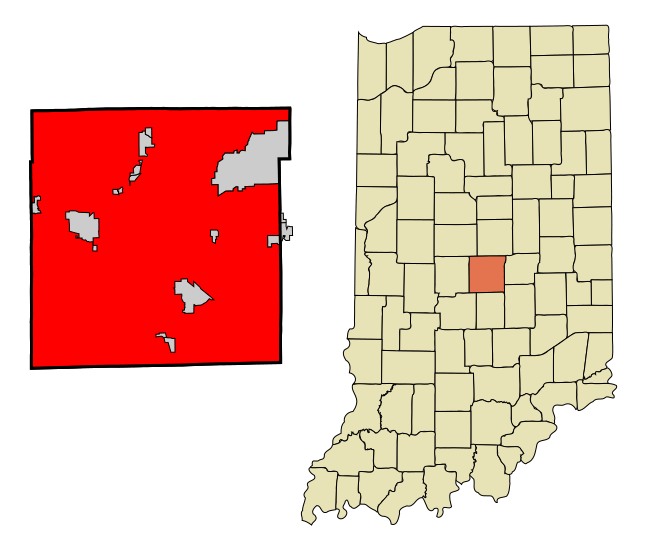 Photo: Indianapolis-Marion County, via kids.kiddle.co
The pattern is consistent. Litigation defines the problem with clarity that political processes often cannot achieve. It forces parties to articulate their interests explicitly and to accept a binding resolution. But it resolves individual disputes rather than systemic conditions, and the cumulative effect of many individual resolutions is rarely the coherent urban form that any planner would have designed intentionally.
The Stranger in Robes
What the history of litigation-as-urban-design reveals is not a failure of the legal system. Courts are doing exactly what courts are designed to do: resolving specific disputes according to applicable law. The revelation is about human beings and their relationship to territorial conflict.
Across five thousand years of recorded history, communities facing unresolvable boundary disputes have consistently preferred the authority of an external arbiter to the indefinite continuation of internal conflict. The arbiter might be a king, a priest, a treaty negotiator, or a federal district judge. The function is identical: to provide a resolution that the parties can accept precisely because neither of them chose it. The legitimacy of the outcome derives not from its wisdom but from the process that produced it.
American cities wear the results of this preference in their street grids, their school district lines, their water allocations, and their tax maps. The places look like what they are: the accumulated record of human beings trying to live near one another without agreeing on the terms, and turning, when agreement failed, to whoever had the authority to decide.