The Geography of Survival: How the Great Migration Traveled by Word of Mouth
There is a temptation to describe the Great Migration in the passive voice—as though six million people simply moved, the way water moves, following gravity toward some inevitable destination. The passive voice obscures the mechanism. People did not drift northward. They made decisions based on specific, hard-won intelligence about specific places: which cities had jobs at which factories, which neighborhoods would rent to Black families, which train routes were safer than others, which northern cities had police forces that behaved differently from the ones being fled.
This intelligence had to be gathered, verified, encoded, and transmitted across hundreds of miles of hostile territory. The people who accomplished this were not intelligence professionals. They were barbers, ministers, Pullman porters, and letter-writers. The system they built was informal, redundant, and remarkably effective—and it illuminates something fundamental about how human beings share knowledge when the official channels are closed to them.
The Newspaper That Southern Postmasters Tried to Bury
The Chicago Defender, founded in 1905 by Robert Abbott, became the most important geographic document of the Great Migration. It was not a map in any conventional sense, but it functioned as one. Its pages were dense with actionable information: which northern cities were hiring, what wages looked like compared to southern sharecropping arrangements, which neighborhoods had Black churches and schools and social organizations, what the legal situation was for Black residents in various states.
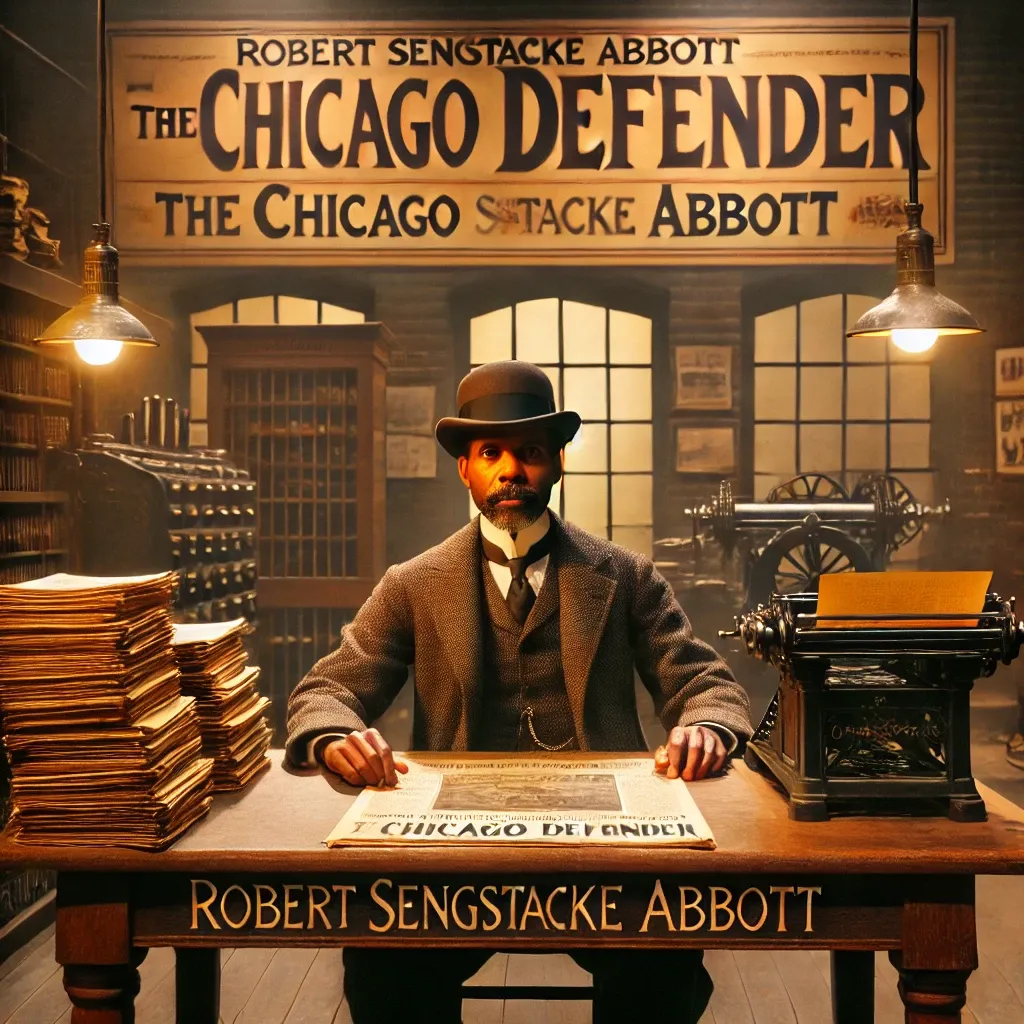 Photo: Robert Abbott, via blackdollarandculture.blog
Southern white authorities understood the Defender's function immediately and moved to suppress it. In many parts of the Deep South, selling or distributing the paper was effectively prohibited—postmasters refused to handle it, sheriffs threatened distributors, and employers warned workers against being found with it. The paper responded by routing itself through the Pullman porter network. Black men who worked the sleeping cars of the major rail lines carried bundles of the Defender southward on their runs and distributed them through a chain of trusted contacts in cities and towns along the routes.
This distribution system was a masterpiece of informal logistics. It exploited the one occupation that required Black men to move freely across the geography of the South—the railroad—and turned it into a supply chain for subversive information. The porters were not paid for this work. They did it because the information mattered, and because they understood that the geography of opportunity they were helping to transmit was real.
The Barbershop as Intelligence Node
In any community where formal institutions are inaccessible or hostile, informal gathering places absorb their functions. The Black barbershop in the early twentieth-century South was simultaneously a place of commerce, a social club, a news exchange, and a remarkably efficient information clearinghouse.
A man who had a cousin in Detroit, or a brother in Chicago, or a church contact in Philadelphia, brought what he knew to the barbershop. The information was tested against other accounts, updated with newer arrivals, and passed along to men who were considering the same move. This was not gossip in any trivial sense. The stakes of a wrong decision were severe. A family that relocated to a city only to find that the factory had stopped hiring, or that the neighborhood they had been told was welcoming was in fact dangerous, faced destitution with no safety net and no easy path home.
The barbershop network imposed a kind of quality control on the information it circulated. Accounts that proved unreliable damaged the credibility of the person who had offered them. Accounts that proved accurate enhanced it. Over time, certain individuals became recognized as particularly reliable sources—people whose contacts in particular cities were known to be current and trustworthy. This is the same mechanism that makes peer review work, or that makes Yelp reviews useful when they are useful. It is a very old technology.
Letters as Encoded Geography
The letters that migrants sent home from northern cities have been studied by historians for their emotional content—the mingled pride and homesickness, the careful reassurances to worried parents, the vivid descriptions of urban life. Less attention has been paid to their function as geographic documents.
These letters were frequently read aloud in churches and community gatherings. A letter describing the specific wage rates at a particular Chicago meatpacking plant, or the address of a boarding house run by a trustworthy woman from the writer's home county, or the name of a foreman who was known to hire without discrimination—this was information of immediate practical value to everyone in the room. The letter was a geographic dispatch from a place most of the audience had never seen, written by someone whose judgment they trusted because they knew them.
The encoding was sometimes literal. In areas where mail was known to be read by white postmasters or employers, writers developed conventions for discussing migration plans obliquely. References to visiting a cousin, to checking on a business matter up north, to taking a trip for health reasons—these were understood by recipients who had no trouble reading between the lines. The code was not sophisticated by cryptographic standards, but it did not need to be. It only needed to be opaque to people who were not already embedded in the social network that gave it meaning.
What Informal Networks Do That Official Ones Cannot
The Great Migration's information infrastructure was, by any objective measure, inferior to what a well-funded official relocation program could have provided. It was slower, less systematic, and prone to the distortions that affect any chain of transmission. And yet it moved six million people with a success rate that formal programs—including the various government relocation efforts of later decades—have rarely matched.
The reason is not mysterious. Informal networks transmit not just information but trust. When a man in Mississippi decided to move his family to Cleveland based on a letter from his church deacon's nephew, he was not acting on raw data. He was acting on a social relationship that gave the data meaning and credibility. The information was embedded in a web of mutual obligation and shared identity that no government pamphlet could replicate.
This is not a lesson that is easy to operationalize, but it is a lesson that history teaches with unusual consistency. Every major population movement in the recorded past—the settlement of the American frontier, the waves of European immigration in the nineteenth century, the internal migrations of wartime—has been guided primarily by informal networks rather than official channels. The official channels follow after the fact, documenting and regulating a movement that was already well underway.
The Record of a Journey That Left No Official Trace
The Great Migration reshaped American geography in ways that are still being reckoned with. The Black neighborhoods of Chicago, Detroit, New York, and Los Angeles—with their churches, their cultural institutions, their political organizations, their music—are the physical residue of decisions made in barbershops and church basements and at kitchen tables, based on information passed hand to hand across a hostile landscape.
History is the only laboratory where we can observe human beings navigating genuinely consequential choices with genuinely imperfect information. The Great Migration is one of its most instructive experiments. It demonstrates that people denied access to formal knowledge networks do not simply go without knowledge. They build something else—slower, more personal, more dependent on trust—and they make it work.