The Bureaucrat's Quarantine: How American Zoning Codes Became the Architecture of Exclusion

The Neutral Language of Exclusion
There is a certain elegance to a tool that accomplishes a controversial purpose while appearing to serve no purpose at all. American municipal zoning codes, in their mature twentieth-century form, represent perhaps the most successful example of this principle in the country's administrative history. They are written in the language of traffic flow, fire safety, and orderly land use. They speak of floor-area ratios and parking minimums and permitted uses in commercial districts. They do not, as a rule, mention the ideas or the people they are designed to keep out. They do not need to.
The legal architecture of explicit exclusion—racially restrictive deed covenants, openly discriminatory business licensing, direct prohibitions on assembly—was progressively dismantled across the mid-twentieth century through a combination of court decisions and federal legislation. What replaced it was not, in most cases, genuine openness. It was a more sophisticated form of the same gatekeeping, translated into the administrative language of urban planning and applied with the creative flexibility that American municipal governments had always brought to the project of defining who belonged.
Use Classifications and the Disappearing Bookstore
The bookstore presents a useful entry point because it is an institution that has found itself on the wrong side of zoning codes in enough distinct historical contexts to constitute a pattern.
In the years following World War II, as American cities began the aggressive suburbanization that would reshape the national landscape, independent booksellers that stocked politically heterodox material—labor literature, socialist periodicals, works by authors under FBI scrutiny—found themselves subject to a particular form of regulatory attention. The attention rarely took the form of direct prohibition, which would have raised First Amendment questions. It took the form of business licensing complications, building code enforcement actions, and use-classification decisions that placed political bookshops in commercial categories subject to heightened scrutiny or parking requirements that small operators on urban lots could not practically satisfy.
Los Angeles in the 1950s provides documented examples. The city's planning department, operating under codes that gave inspectors significant discretionary authority over which establishments qualified as retail versus which fell into more restrictive categories, applied that discretion in ways that consistently disadvantaged shops associated with left-wing political organizations. The tools were technical. The outcomes were political. The paper trail, where it survived, shows inspectors citing violations in establishments that had operated without incident for years, with the timing of enforcement actions correlating closely with the political activities of the proprietors.
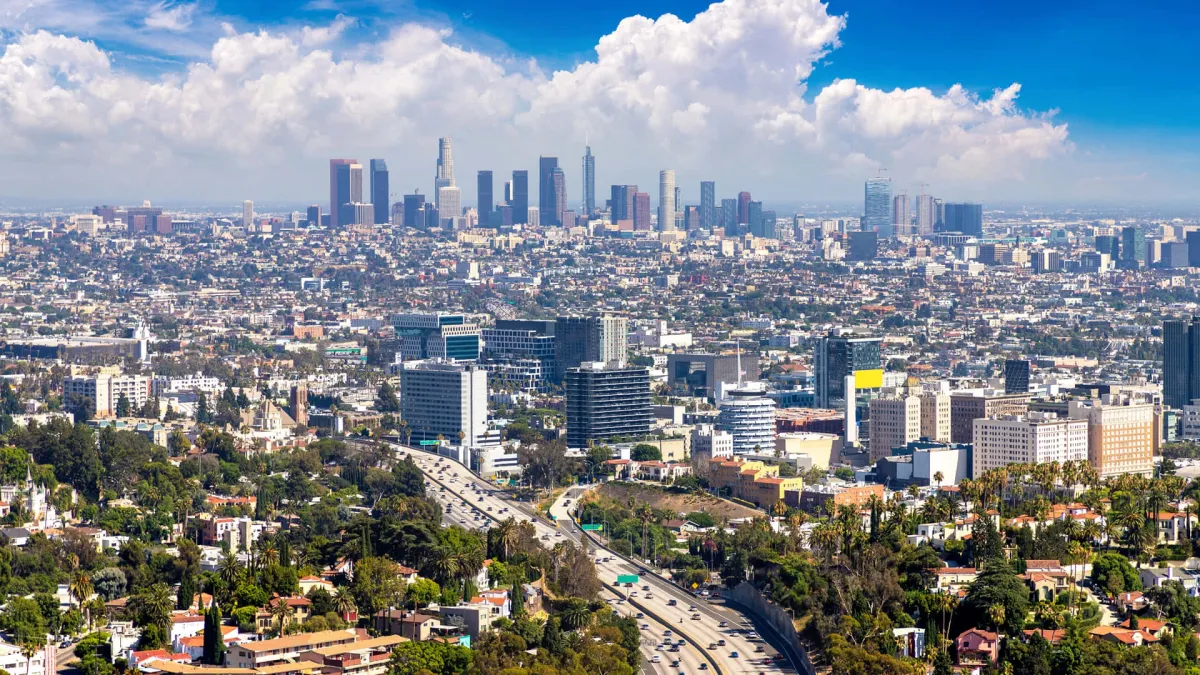 Photo: Los Angeles, via wallpapers.com
This was not unique to Los Angeles, and it was not unique to the Cold War period. The pattern of using technical regulatory authority to accomplish political exclusion appears consistently across American municipal history, adapting its specific instruments to the specific vulnerabilities of whatever institution it targets.
Meeting Halls and the Geometry of Assembly
The regulation of physical assembly space represents a related and equally instructive case. The right to assemble is constitutionally protected. The physical structures in which assembly occurs are subject to municipal regulation, and the distance between those two facts has provided American local governments with considerable operational room.
Labor organizations in the early twentieth century encountered this most directly. The period between 1900 and 1940 produced extensive documentation of municipalities using building codes, occupancy limits, and zoning classifications to constrain the meeting spaces available to unions and labor organizers. The mechanisms were varied. Some cities required meeting halls to maintain parking ratios that were impossible in the dense urban neighborhoods where workers actually lived. Others applied fire code interpretations that required expensive structural modifications to buildings that had been in continuous use for decades without incident—modifications that happened to be required only after the buildings were acquired by organizations the city government found inconvenient.
The city of Paterson, New Jersey, which had a substantial history of labor organizing in its textile industry, provides a well-documented example. Following the 1913 silk workers' strike, city officials applied building and zoning requirements to union halls with an aggressiveness that had not been evident before the strike. The technical justifications were real—the buildings did have the violations cited—but the selective timing of their enforcement made the political purpose transparent to anyone who examined the record, which few people outside the labor movement did.
 Photo: Paterson, New Jersey, via c8.alamy.com
Parking Minimums as Cultural Policy
The parking minimum is among the most consequential and least examined instruments in the history of American exclusionary zoning. Requiring that any commercial establishment maintain a specified number of off-street parking spaces per square foot of floor area seems, on its surface, like a neutral traffic management measure. In practice, it has functioned as a highly effective mechanism for determining which kinds of establishments can exist in which kinds of places.
Small, independent institutions—the community meeting hall, the neighborhood health clinic, the storefront legal aid office—typically operate on urban lots that predate the automobile and cannot accommodate large parking facilities. The imposition of parking minimums on such institutions, when applied selectively or calibrated to requirements that small operators cannot meet, accomplishes their elimination through arithmetic rather than prohibition.
The application of this tool to abortion providers beginning in the 1980s and accelerating through the 1990s and 2000s represents one of the most extensively documented cases of zoning used as ideological instrument. Several states passed legislation requiring abortion clinics to meet the physical plant standards of ambulatory surgical centers—corridor widths, parking ratios, procedure room dimensions—that existing clinics could not meet without complete reconstruction. The medical justification for these requirements was disputed by major medical associations, who noted that the procedures performed did not require surgical-center infrastructure. The practical effect was the closure of facilities that had operated safely for years. The mechanism was architectural. The intent, as recorded in the legislative histories of several states, was not.
The Ancient Instinct in Modern Bureaucratic Clothing
What the history of exclusionary zoning reveals is not a modern innovation but an ancient pattern in modern dress. The impulse to define community membership through control of physical space is documented across human societies for as long as records exist. Greek city-states regulated which foreigners could own property within their walls. Medieval European towns used guild regulations and residency requirements to determine who could practice which trades in which locations. Colonial American communities used property qualifications and physical distance requirements to control access to town centers.
The specific bureaucratic vocabulary changes. The underlying psychology does not. What changes with the development of modern zoning is the degree of technical sophistication available to the exclusionary impulse—the ability to accomplish through floor-area ratios and use classifications what earlier communities accomplished through more direct instruments, while maintaining the appearance of neutral administration.
The record of American places is full of this translation work. The quarantine instinct—the desire to protect a community's perceived identity by controlling what ideas, institutions, and people can physically occupy its space—has never required a particular legal instrument. It has always found whatever instrument was available. The history of how it found zoning is a history worth understanding, not because it is exceptional, but because it is so thoroughly ordinary.