Cardboard Permanence: The Architectural Bluff That Invented American Main Street
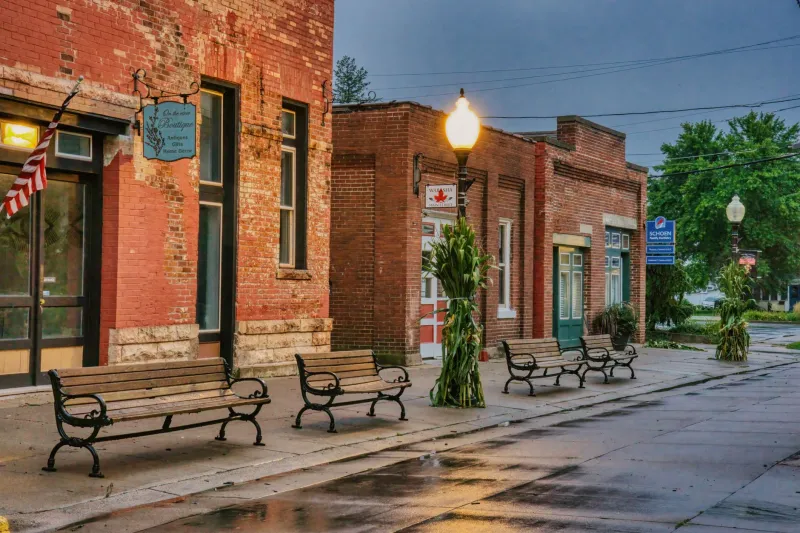
Stand on almost any small-town Main Street in the American interior and you will be looking at a confidence game. The two-story brick facades, the arched windows, the decorative cornices—the entire visual grammar of prosperous small-town commerce—were, in a remarkable number of cases, built not because the towns they fronted were thriving but because the speculators who built them needed you to believe they were.
Architecture, in the American frontier context, was not primarily a response to commercial need. It was a marketing instrument. And understanding that changes how you see nearly every Main Street you will ever walk.
The Product Was the Appearance of a Product
The mechanics of frontier town promotion followed a recognizable pattern. A speculator or land company would acquire a plat of prairie land, file a town plan with the county, and immediately set about creating evidence that the town already existed in some meaningful sense. Newspapers were established before subscribers arrived. Hotels were built before travelers had reason to visit. And commercial buildings—substantial, permanent-looking, brick where possible—were erected on lots that had not yet attracted the businesses they were designed to house.
The logic was self-reinforcing and psychologically sophisticated. Settlers evaluating potential destinations in the 1860s through the 1890s made decisions based on perceived momentum. A town that looked established attracted settlers who made it more established. A town that looked provisional attracted skepticism that confirmed its provisionality. The speculator's job was to manufacture the appearance of momentum before momentum existed.
This was not fraud in any simple sense—the land was real, the buildings were real, the intentions were often genuine. But the relationship between the built environment and the commercial reality it implied was systematically and deliberately inverted. The buildings came first. The businesses were supposed to follow.
The False-Front as Honest Metaphor
The most literal expression of this dynamic was the false-front building: a wooden structure given a facade that extended above the actual roofline to suggest a larger, more substantial building behind it. False fronts were common in early western towns precisely because they were cheap to build and effective at their primary purpose, which was visual deception at a distance.
But the false front was only the most transparent version of a more pervasive practice. Even genuinely brick buildings, solidly constructed and architecturally elaborate, frequently housed interiors that bore no relationship to their exteriors. Upper floors, which in the eastern cities these facades were imitating would have contained offices or residences, often sat empty for years or decades. The ground-floor commercial space was real. Everything above it was aspiration rendered in masonry.
The pattern is consistent enough across enough towns to constitute a system rather than a collection of individual decisions. Speculators in competing towns were essentially engaged in an architectural arms race, each trying to produce a built environment convincing enough to attract the settlers and rail lines that would validate the investment. The towns that won this race became genuine commercial centers. The ones that lost became the ghost towns and near-ghost towns that dot the American interior—their elaborate brick facades now serving as monuments to a promotional campaign that ultimately failed.
What the Settlers Were Actually Buying
The settlers who responded to these architectural signals were not simply being deceived. They were, in many cases, making a rational bet. A town with substantial brick construction had, at minimum, a speculator willing to invest capital in it. That was not nothing. The buildings were a form of credible commitment—evidence that someone with money believed in the place enough to put money into it.
This is a pattern with deep roots in human economic behavior. Signals of investment have always functioned as proxies for quality in situations where quality itself is difficult to observe directly. The elaborateness of a frontier town's commercial architecture was, in this sense, a signal—imperfect and frequently manipulated, but not entirely uninformative.
The problem was that the signal was too easy to fake. Erecting a two-story brick facade required capital, but not nearly as much capital as building a genuinely thriving town. The gap between the cost of the signal and the cost of the underlying reality it implied was wide enough to accommodate an enormous amount of strategic misrepresentation.
The Psychological Residue
What is striking, from a historical distance, is how completely this architectural vocabulary became naturalized. The brick commercial storefront, the decorative cornice, the second-story windows looking out over a commercial street—these elements were absorbed into the American visual lexicon of prosperity so thoroughly that they lost their promotional origins entirely.
By the mid-twentieth century, these buildings were no longer read as arguments for a town's viability. They were simply what Main Street looked like. Their persuasive function had been so successful that it became invisible.
This is the mechanism by which successful propaganda always works. The message disappears into the landscape, becoming not a claim about reality but reality itself.
The Same Trick, Different Materials
The contemporary equivalents are not difficult to identify. The lifestyle district—a carefully curated commercial zone featuring exposed brick, artisanal signage, and a particular density of coffee shops and boutique retailers—performs exactly the same function as the frontier speculator's false-front Main Street. It manufactures the appearance of organic commercial vitality in order to attract the residents and investors whose presence will, if the bet pays off, eventually produce something approximating the vitality it initially only implied.
Mixed-use developments in formerly industrial neighborhoods deploy the same logic at larger scale. The architectural vocabulary changes—raw concrete and steel rather than brick and cornice—but the underlying psychology is identical. Build the appearance of a thriving place. Hope the appearance generates the reality.
Real estate developers understand this intuitively, even when they do not articulate it in these terms. The model unit, the staged lobby, the rendering that shows a building surrounded by trees that do not yet exist—these are all versions of the same confidence game that built Main Street.
The Record the Buildings Keep
What makes this history worth recovering is not the exposure of past dishonesty. The speculators who built these towns were operating within the norms of their era, and many of them lost everything when their towns failed to materialize. The history is worth recovering because it clarifies something about the relationship between built environments and the communities they house.
Buildings are not passive containers for human activity. They are arguments. They make claims about what a place is and what it is becoming. Those claims can be honest or misleading, fulfilled or disappointed. But they are always, at some level, rhetorical.
The Main Street you walk down today—the one that feels timeless and organic and authentically American—is in many cases the surviving physical evidence of a sales pitch made to people who are now long dead. Some of them were convinced. Some of them lost everything. The building does not distinguish between these outcomes. It simply stands there, looking permanent, performing exactly the function it was designed to perform.