When Staying Becomes the Irrational Choice: The Psychology of Communities That Choose to Leave
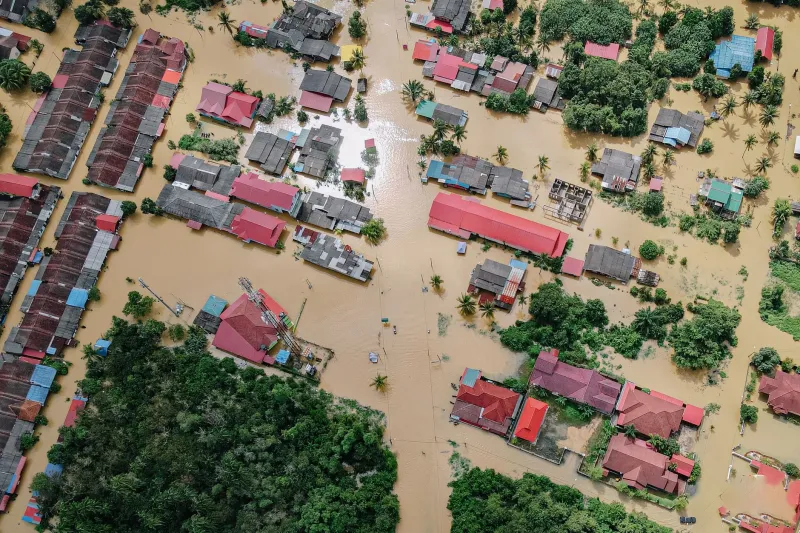
There is a story Americans tell themselves about place. It is a story of permanence, of roots driven deep into particular soil, of communities that endure because endurance is itself a virtue. The story is emotionally powerful and historically useful. It is also, in a measurable number of cases, lethal.
A handful of American communities have recently begun telling a different story—one that is older, less sentimental, and arguably more honest about how human beings have always related to geography. They have chosen to move.
The Isle de Jean Charles Experiment
Isle de Jean Charles, a narrow strip of land in Terrebonne Parish, Louisiana, has lost roughly 98 percent of its landmass since 1955. The island—home to a community of Biloxi-Chitimacha-Choctaw tribal members whose ancestors were pushed onto this marginal land by the same government now proposing to move them again—sits so low in the Gulf that routine tidal surges now wash over roads that were once dry ground in the middle of summer.
In 2016, Louisiana received a $48 million federal grant to relocate the remaining residents to higher ground north of Houma. The process has been halting, contested, and emotionally brutal. Some residents have refused to go. Others have already left informally, driven by flooding rather than federal planning. The formal relocation project has moved far more slowly than the water.
What Isle de Jean Charles illustrates is not a policy failure, though it is partly that. It illustrates the gap between the intellectual recognition that a place is becoming uninhabitable and the psychological capacity to act on that recognition. Human beings are extraordinarily poor at making rational decisions about places they love. This is not a character flaw. It is a documented feature of how memory, identity, and physical geography become entangled in the human mind.
Valmeyer and the Rarer Story
Valmeyer, Illinois, offers a counterexample that deserves more attention than it typically receives. When the Mississippi River flood of 1993 inundated the town—the worst flooding in the region's recorded history—Valmeyer's residents voted, by a substantial margin, to relocate the entire community to a bluff roughly two miles away and 400 feet higher.
The new Valmeyer was built on farmland. Streets were platted from scratch. A new school, a new water tower, a new post office. The old townsite was largely returned to floodplain. By any conventional measure, the relocation succeeded: the community survived, retained its institutional identity, and avoided the cycle of repetitive flood damage that has consumed federal disaster funds in dozens of comparable river towns.
The Valmeyer case is instructive precisely because it was not painless. Residents described the experience of watching their former homes demolished or abandoned as genuinely grievous. The emotional difficulty was real. The community chose to absorb that difficulty rather than absorb another flood.
This is the threshold that matters—not the absence of attachment, but the decision, made collectively and consciously, that attachment cannot be allowed to override survival.
An Ancient Calculation
Managed retreat sounds like a modern planning concept, and in its formal bureaucratic form it is. But the underlying behavior is as old as human settlement. Archaeological and historical records are dense with examples of communities that relocated in response to environmental change, resource depletion, or persistent violence. The puebloan peoples of the American Southwest moved their settlements repeatedly over centuries in response to drought cycles. Medieval European villages were relocated—sometimes by lords, sometimes by collective decision—when flooding, plague, or soil exhaustion made their original sites untenable.
The historical record suggests that the communities that survived over long periods were precisely those capable of treating geography as a tool rather than an identity. The ones that could not make that distinction often simply disappeared.
This is the editorial concept that Record of Places returns to repeatedly: human psychology has not changed in five thousand years, and the laboratory of history makes that legible in ways that no controlled experiment can replicate. The same cognitive pattern that made Valmeyer residents reluctant to leave their flooded homes made medieval villagers cling to plague-ridden settlements long after the rational calculus had turned decisively against them.
Why Refusal Is Not Necessarily Courage
American political culture has a particular tendency to frame resistance to relocation as admirable. The holdout, the stubborn homeowner who refuses the buyout, the community that insists on rebuilding in the same floodplain for the fourth time—these figures are frequently cast as embodiments of resilience. The framing is worth examining.
Resilience, properly understood, is the capacity to absorb disruption and reorganize. It is not synonymous with staying in one place. A community that relocates and reconstitutes itself on safer ground has demonstrated a form of resilience that is arguably more sophisticated than one that simply rebuilds the same structure in the same location and waits for the next disaster.
The federal government's repetitive loss program—which tracks properties that have been flooded and rebuilt with federal assistance multiple times—contains more than 30,000 properties nationwide. Some individual properties have been flooded and rebuilt more than ten times. The aggregate cost to the National Flood Insurance Program runs into the billions. The communities in which those properties sit are not demonstrating resilience. They are demonstrating the human capacity to mistake familiarity for safety.
The Politics of Moving
Voluntary community relocation is not simply a psychological challenge. It is a political one of considerable complexity. Any proposal to move a community immediately fractures along lines of age, tenure, and economic stake. Long-term residents with deep social networks and property equity tend to resist most strongly. Younger residents and renters, who have less accumulated investment in the specific geography, are more likely to favor relocation—and are also less likely to have meaningful political voice in local governance.
This dynamic is not accidental. It mirrors patterns observable throughout recorded history in which those with the most to lose from change are structurally positioned to prevent it, even when the change would benefit the community as a whole. The result, in town after town, is a political equilibrium that favors managed decline over managed relocation—a choice that is rarely described as a choice at all.
What the Leaving Reveals
The communities that have successfully relocated share certain characteristics. They tend to have experienced a single catastrophic event rather than slow degradation—flooding is more galvanizing than gradual demographic decline. They tend to have strong existing social institutions, particularly churches and schools, that can serve as organizational anchors during the transition. And they tend to have leadership capable of reframing relocation not as abandonment but as continuity: the community is moving, not dissolving.
That reframing is not dishonest. It is psychologically accurate. The Isle de Jean Charles community, if it fully relocates, will carry its tribal identity, its kinship networks, and its cultural practices to higher ground. What it will leave behind is a particular arrangement of water and sediment that has, over the past seven decades, been steadily reclaiming itself from human occupation.
The places that endure in any meaningful sense are not the ones that refuse to move. They are the ones that understand the difference between a community and a coordinate.