Saved by Accident: The American Landmarks That Nearly Vanished Into Indifference
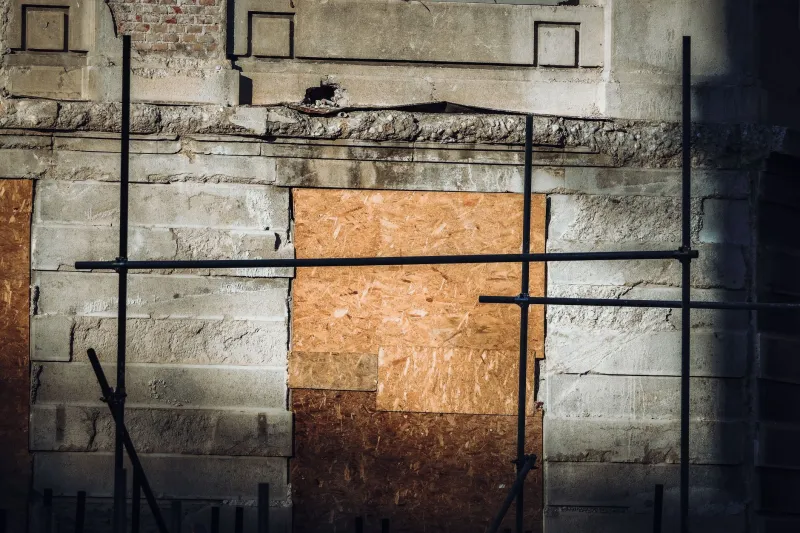
The stories Americans tell about historical preservation tend to feature a villain. A highway department that wanted to bulldoze a neighborhood. A developer who saw profit where others saw heritage. A government agency indifferent to everything built before the current administration. These narratives are satisfying because they give preservation its dramatic structure: the irreplaceable artifact, the hostile force, the last-minute rescue.
But a significant portion of America's most important surviving structures were not saved from enemies. They were saved, barely, from nothing—from the slow attrition of neglect, from the bureaucratic momentum of institutions that had simply stopped paying attention, from the economic logic of buildings that had outlived their original purpose without yet acquiring the cultural prestige that might justify their maintenance. The near-death experience of these places, examined carefully, reveals something that no laboratory study of memory and attachment could easily replicate: the precise conditions under which a community decides that a place is worth remembering.
The Psychology of Forgetting in Place
Human beings are not, by nature, reliable custodians of their own past. The psychological literature on memory is unambiguous on this point: we remember what we rehearse, and we rehearse what we value, and what we value is almost always determined by present circumstances rather than historical significance. A building that once housed a pivotal moment in a community's history becomes, over time, simply the building on the corner—an obstacle to parking, a liability on the municipal balance sheet, a structure whose maintenance costs exceed any obvious economic return.
This is not callousness. It is the ordinary operation of human cognition applied to the built environment. The challenge of preservation is not primarily architectural or financial; it is psychological. It requires a community to sustain, across generations, an active identification with a past that recedes further from lived experience with each passing year. When that identification fails—when the people who remember what happened in a place are replaced by people who only know that something old stands there—the building enters its most dangerous period.
The historical record is full of structures that survived their dangerous period by the narrowest of margins, and the circumstances of their survival are revealing.
Independence Hall and the Long Years of Irrelevance
The building now considered the most sacred site in American civic mythology spent the better part of the nineteenth century in a condition of dignified but genuine neglect. After the federal government moved to Philadelphia and then to Washington, Independence Hall became a Pennsylvania state property without a clear state purpose. Various proposals circulated over the decades for its conversion or replacement. The city of Philadelphia, at one point in the 1810s, seriously entertained an offer from a private developer who wanted to purchase the land surrounding the hall and construct commercial buildings on the site—a transaction that would almost certainly have doomed the structure to eventual demolition through the familiar mechanism of surrounding it with more economically productive uses until its own maintenance became impossible to justify.
What saved Independence Hall was not a dramatic preservation campaign. It was a combination of political inertia, the gradual accretion of symbolic significance as the nation aged, and the specific intervention of several individuals whose attachment to the building was, by the standards of their era, eccentric. The hall's survival into the period when American historical consciousness fully crystallized around the founding generation was not inevitable. It was contingent—dependent on a series of decisions that could easily have gone differently.
This contingency is the lesson. The building did not survive because its importance was self-evident. Its importance became self-evident, in part, because it survived.
The Factory That Became a Symbol It Never Intended to Be
Lowell, Massachusetts presents a different case study in accidental preservation. The textile mills that made Lowell the first planned industrial city in America were, by the mid-twentieth century, economic liabilities in a declining industrial region. Several mill complexes were demolished without significant opposition during the urban renewal era. Others survived only because demolition was expensive, because the buildings were structurally sound enough that no immediate safety concern forced a decision, or because the economics of replacement construction were temporarily unfavorable.
The transformation of Lowell's surviving mill district into a National Historical Park in 1978 required a fundamental reframing of what those buildings meant. For decades after the mills ceased active production, they represented industrial decline—visible evidence of an economy that had moved on. The preservation argument required persuading a community, and eventually a Congress, that the same structures that embodied failure could be reconceived as evidence of origin, that the story of American industrial labor was worth commemorating in the same way that military victories and political founding moments were commemorated.
This reframing succeeded, but it succeeded late. Several of the buildings that would have been most significant to the interpretive program of the park had already been lost. What survives in Lowell is not the complete record of early American industrialization; it is the portion of that record that happened to endure the decades between industrial decline and cultural rehabilitation. The gap between those two moments is where the forgetting happened, and it happened not through malice but through the simple absence of a reason to act otherwise.
What Near-Demolition Teaches
The pattern across these cases—and across dozens of similar near-losses documented in preservation records from every region of the country—is consistent. Structures are most vulnerable not when they are actively threatened but when they have become invisible: present enough to generate maintenance costs, absent enough from collective consciousness that no constituency forms to defend them.
The communities that successfully preserved their significant places, even accidentally, tended to share a characteristic that is difficult to manufacture but easy to identify in retrospect: some group of people maintained a continuous, active narrative about why the place mattered. Not necessarily a formal preservation organization, not necessarily a politically powerful constituency—sometimes just a handful of individuals who kept telling the story, who made sure the building appeared in local histories and school curricula and newspaper anniversary features, who kept the identification between place and memory alive during the years when economic logic argued for demolition.
This is, again, a finding about human psychology rather than architecture. Memory is not stored in buildings. It is stored in people, and transmitted through the stories people tell about buildings, and the buildings survive when enough people are telling enough stories to create a political and economic environment in which demolition becomes harder than preservation.
The history that did not survive—the structures that fell to indifference before anyone organized to defend them—is by definition invisible. We cannot study what was lost before it was recognized as significant. But the near-misses are available for examination, and they suggest that the threshold between survival and erasure is far lower, and far more dependent on accident and individual action, than the triumphant narratives of preservation history typically acknowledge.
The laboratory of the past does not offer controlled experiments. It offers the complete record of every decision that was made and every decision that was deferred until the building was gone. Both kinds of decisions are instructive.