Swamp Diplomacy: How Malaria Quietly Governed the American Capital
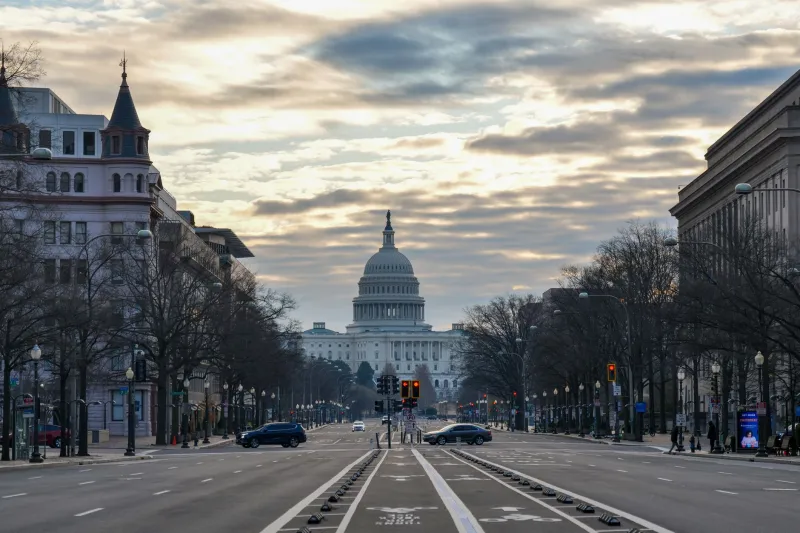
There is a version of American political history that attributes the peculiarities of Washington D.C. to Pierre Charles L'Enfant's grandiose vision, or to the compromises of the Constitutional Convention, or to the slow accretion of federal ambition over two and a half centuries. That version is incomplete. For the better part of a century, the city's most influential urban planner was Plasmodium vivax—the protozoan parasite responsible for malaria—and it never once attended a planning meeting.
 Photo: Pierre Charles L'Enfant, via www.pierres-de-lumiere.com
 Photo: Washington D.C., via logos-world.net
Human psychology has not changed in five thousand years. What changes is the name we give to the forces that constrain us, and whether we are honest about identifying them.
The Deliberate Choice of Unhealthy Ground
The selection of the Potomac tidal flats as the site of the permanent federal capital was, by any epidemiological standard, a catastrophic decision. The land that would become the District of Columbia sat at the confluence of two rivers, surrounded by tidal marshes that bred mosquitoes in quantities that contemporaries described with something approaching awe. George Washington, who owned land nearby and understood the terrain intimately, nonetheless endorsed the location. The political calculus—satisfying both Northern and Southern factions by placing the capital at a geographic midpoint—outweighed the biological reality.
This is not an unusual human calculation. Throughout recorded history, communities have chosen sites for reasons of status, commerce, or political convenience, and then spent generations engineering workarounds for the predictable consequences. Washington was simply more honest about its dysfunction than most.
By the early 1800s, the consequences were undeniable. Malaria—then called simply "the fever" or "the ague"—struck the city's residents with seasonal regularity. Workers excavating the canal system that L'Enfant had imagined as a commercial artery died in numbers that went largely unrecorded. Enslaved laborers who built the Capitol and the White House were exposed to conditions that the historical record only partially captures.
Hazard Pay and the Diplomatic Exemption
The foreign diplomatic corps noticed what American politicians preferred not to discuss. By the 1820s and 1830s, several European governments had formally classified Washington D.C. as a hardship posting, entitling their ambassadors and ministers to additional compensation for the health risks involved. The British Foreign Office was among the most explicit: service in Washington carried allowances comparable to assignments in tropical colonial outposts. This was not diplomatic theater. Ministers genuinely sickened and died at rates that alarmed their home governments.
The practical effect was significant. Ambassadors rotated through Washington on shortened tours. Embassies were staffed at reduced levels during summer months. Diplomatic correspondence from the period is laced with references to illness, recovery, and the desperate desire to escape to higher, drier ground before August arrived. The social season in Washington was structured, in part, around the window of relative safety that the cooler months provided—a rhythm that persists, in vestigial form, in the city's cultural calendar to this day.
Congress Learns to Adjourn
The institution most visibly shaped by malaria was the one least willing to acknowledge it. Congress, whose members arrived from across the country and lacked the partial immunity that long-term Washington residents sometimes developed, suffered annual attrition from the fever. The solution, arrived at gradually and never formally attributed to disease, was the summer recess.
For most of the nineteenth century, Congress adjourned in late spring or early summer and did not reconvene until autumn. The timing was not accidental. It mapped almost precisely onto the peak transmission season for malaria in the mid-Atlantic region. Legislators who remained in Washington through August risked genuine illness. Those who returned to their home districts—most of which were at higher elevations or in less marshy terrain—recovered. The recess was, functionally, a public health measure dressed in the language of legislative scheduling.
This pattern persists. The modern congressional recess retains its August core, long after the epidemiological rationale has vanished. Institutions, once shaped by a force, tend to preserve the shape even after the force has departed. The behavior outlives the cause. This is among the most consistent findings across five thousand years of recorded human organization.
The Architecture of Avoidance
The city's physical form also bears the imprint of the fever. The decision to keep federal buildings relatively low—a characteristic that later acquired the retrospective justification of preserving sightlines to the Capitol dome—had earlier practical dimensions related to site drainage and the perceived health advantages of elevation and air circulation. Miasma theory, the pre-germ understanding of disease that attributed illness to "bad air" rising from decomposing organic matter, shaped urban design across the nineteenth century. In Washington, where bad air was genuinely abundant, the theory drove real engineering choices.
Street grades were raised. The city's infamous canal, running through what is now the National Mall, was eventually filled in partly because it had become an open sewer and a mosquito breeding ground of spectacular productivity. The filling of that canal—completed in stages through the late nineteenth century—was one of the single most consequential public health interventions in the city's history, though it is remembered today, if at all, as a landscaping decision.
The buildings that cluster along the Mall's edges, the relative openness of the monumental core, the absence of the dense low-lying commercial development that characterized other American cities of comparable size—all of these reflect, at some distance, the accumulated decisions of people trying to make a malarial swamp into a functional seat of government.
What the Fever Teaches
The history of Washington D.C. and malaria is, at its core, a study in how institutions absorb environmental constraints and then forget they ever did so. The congressional recess no longer saves lives. The height limits no longer reflect miasmatic theory. The drainage systems no longer represent emergency public health engineering. But the patterns remain, encoded in law, custom, and stone, carrying the logic of a threat that most Americans now associate exclusively with sub-Saharan Africa or Southeast Asia.
The lesson is not that malaria was uniquely powerful, or that Washington was uniquely susceptible to environmental determinism. The lesson is that every institution is partially the product of pressures its current members never experienced and cannot name. The most important forces shaping any organization are often the ones that have already done their work and departed, leaving only the behavioral residue behind.
History is the only laboratory that never closes. Washington D.C. is one of its more eloquent specimens—a city that still observes the rhythms of a disease it no longer fears, and calls those rhythms tradition.